
§ 170

Law § 170 of Hammurabi's Code

Translation
If a man’s wife bore him children and his slave bore him children, (and) the father during his life said to the children that the slave bore him, “my children,” he has included them with the children of the wife; after the father has passed on, the children of the wife and the children of the slave will share in the property of the paternal estate equally; the chief heir of the wife will take first choice of the inheritance.
Law Group

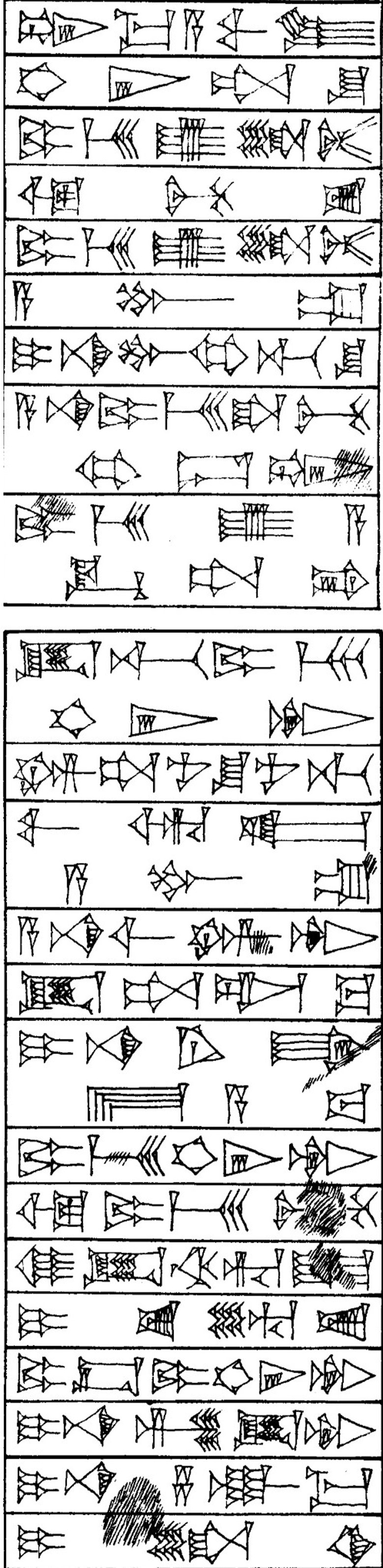
Cuneiform

Law § 170 - Cuneiform - Law Code of Hammurabi

Source: Bergmann (1953, p. 21–22, col. R XII, lns. 38–60)

Transliteration

šum-ma a-wi-lum ḫi-ir-ta-šu DUMU.MEŠ ú-li-súm ù GEME2-sú DUMU.MEŠ ú-li-súm a-bu-um i-na bu-ul-ṭì-šu a-na DUMU.MEŠ ša GEME2 ul-du-šum DUMU.MEŠ-ú-a iq-ta-bi it-ti DUMU.MEŠ ḫi-ir-tim im-ta-nu-šu-nu-ti wa-ar-ka a-bu-um a-na ši-im-tim it-ta-al-ku i-na NÍG.GA É A.BA DUMU.MEŠ ḫi-ir-tim ù DUMU.MEŠ GEME2 mi-it-ḫa-ri-iš i-zu-uz-zu IBILA DUMU ḫi-ir-tim i-na zi-it-tim i-na-sà-aq-ma i-le-qé

Source: Huehnergard (2011, p. 291)

Normalization

šumma awīlum ḫīrtašu mārī ulissum u amassu mārī ulissum, abum ina bulṭīšu ana mārī ša amtum uldūšum “mārūya” iqtabi, itti mārī ḫīrtim imtanūšunūti; warka abum ana šīmtim ittalku ina makkūr bīt abim mārū ḫīrtim u mārū amtim mitḫāriš izuzzū; aplum mār(i) ḫīrtim ina zīttim inassaq-ma ileqqe.

Source: Huehnergard (2013, p. 69)

Translation

If a man’s wife bore him children and his slave bore him children, (and) the father during his life said to the children that the slave bore him, “my children,” he has included them with the children of the wife; after the father has passed on, the children of the wife and the children of the slave will share in the property of the paternal estate equally; the chief heir of the wife will take first choice of the inheritance.

Source: Richardson (2004, p. 69)

Citation

MLA 9

Dedović, B. "§ 170 - eHammurabi." OMNIKA Foundation, 4 Nov. 2023, ehlaw.org/law/170. [Accessed 14 Nov. 2026]

APA 7

Dedović, B. (2023, November 4). § 170 - eHammurabi. OMNIKA Foundation. https://ehlaw.org/law/170

CMS 16

Dedović, Boban. "§ 170 - eHammurabi." Las Vegas, NV: OMNIKA Foundation. Created November 4, 2023. Modified January 1, 2025. Accessed November 14, 2026. https://ehlaw.org/law/170.

Bibliography

ACH

Abulhab, Saad D. The Law Code of Hammurabi: Transliterated and Literally Translated from its Early Classical Arabic Language. New York, NY: Blautopf, 2017.

CHTP

Bergmann, Eugen. Codex Ḫammurabi: Textus Primigenius. Rome, Italy: Pontificium Institutum Biblicum, 1953.

HAG3

Huehnergard, John. A Grammar of Akkadian (Third Edition). Winona Lake, IN: Eisenbrauns, 2011.

HKEY3

Huehnergard, John. Key to a Grammar of Akkadian (Third Edition). Winona Lake, IN: Eisenbrauns, 2013.

–

OMNIKA Foundation Contributors. "OMNIKA: Digital Mythology Library & Search Engine." Las Vegas, NV: OMNIKA Foundation, accessed November 14, 2023. https://omnika.org. [Visit]

RHL

Richardson, Mervyn E.J. Hammurabi's Laws: Text, Translation and Glossary. New York, NY: T & T Clark International, 2004.

SoT

Sound of Text Contributors. "Sound of Text: AI Text-to-Speech." Accessed November 14, 2023. https://soundoftext.app. [Visit]

eHammurabi Glossary

The § symbol is a shorthand notation for the word 'section'.

Read more

eHammurabi Glossary

Cuneiform is an ancient writing system used by various cultures around Mesopotamia.

Read more

eHammurabi Glossary

Normalization is the application of grammatical rules unto transliterated sound values.

Read more

eHammurabi Glossary

Translation is the conversion of linguistic contents and their meanings from one language into another.

Read more

eHammurabi Glossary

Transliteration is the conversion of sound values from one writing system into another.

Read more