
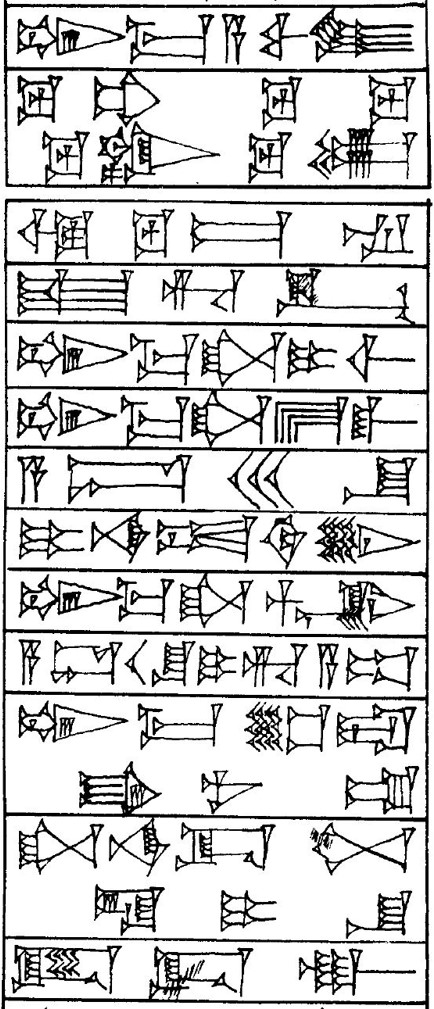
§ 8

Law § 8 of Hammurabi's Code

Summary
as a muškēnum (working-class person), the punishment for stealing certain farm animals from a man, deity, or sacred location is ten times the animals' value; the punishment for inability to pay said value is execution.
Translation
If a man stole either an ox or a sheep or a donkey or a pig or a boat, if it belonged to the god or the palace, he will give up to thirty-fold; if it belonged to a muškēnum, he will give back up to ten-fold; if the thief in question does not have what must be given (or, anything to give) he will be executed.

Cuneiform

Law § 8 - Cuneiform - Law Code of Hammurabi

Source: Bergmann (1953, p. 4–5, col. VI, lns. 57–69)

Transliteration

šum-ma a-wi-lum lu GUD lu UDU lu ANŠE lu šaḫâm(ŠAḪ) ù lu gišMÁ iš-ri-iq šum-ma ša i-lim šum-ma ša É.GAL A.RÁ 30-šu i-na-ad-di-in šum-ma ša MAŠ.EN.GAG A.RÁ 10-šu i-ri-a-ab šum-ma šar-ra-qá-nu-um ša na-da-nim la i-šu id-da-ak

Source: Huehnergard (2011, p. 350)

Normalization

šumma awīlum lū alpam lū immeram lū imēram lū šaḫâm ū lū eleppam išriq šumma ša ilim šumma ša ekallim, adi šalāšāʾīšu inaddin; šumma ša muškēnim, adi ešrīšu irīab; šumma šarrāqānum ša nadānim lā īšu, iddâk.

Source: Huehnergard (2013, p. 88)

Translation

If a man stole either an ox or a sheep or a donkey or a pig or a boat, if it belonged to the god or the palace, he will give up to thirty-fold; if it belonged to a muškēnum, he will give back up to ten-fold; if the thief in question does not have what must be given (or, anything to give) he will be executed.

Source: Huehnergard (2013, p. 88)

Citation

MLA 9

Dedović, B. "§ 8 - eHammurabi." OMNIKA Foundation, 24 Oct. 2023, ehlaw.org/law/8. [Accessed 14 Nov. 2026]

APA 7

Dedović, B. (2023, October 24). § 8 - eHammurabi. OMNIKA Foundation. https://ehlaw.org/law/8

CMS 16

Dedović, Boban. "§ 8 - eHammurabi." Las Vegas, NV: OMNIKA Foundation. Created October 24, 2023. Modified December 15, 2024. Accessed November 14, 2026. https://ehlaw.org/law/8.

Bibliography

ACH

Abulhab, Saad D. The Law Code of Hammurabi: Transliterated and Literally Translated from its Early Classical Arabic Language. New York, NY: Blautopf, 2017.

CHTP

Bergmann, Eugen. Codex Ḫammurabi: Textus Primigenius. Rome, Italy: Pontificium Institutum Biblicum, 1953.

HAG3

Huehnergard, John. A Grammar of Akkadian (Third Edition). Winona Lake, IN: Eisenbrauns, 2011.

HKEY3

Huehnergard, John. Key to a Grammar of Akkadian (Third Edition). Winona Lake, IN: Eisenbrauns, 2013.

–

OMNIKA Foundation Contributors. "OMNIKA: Digital Mythology Library & Search Engine." Las Vegas, NV: OMNIKA Foundation, accessed November 14, 2023. https://omnika.org. [Visit]

RHL

Richardson, Mervyn E.J. Hammurabi's Laws: Text, Translation and Glossary. New York, NY: T & T Clark International, 2004.

SoT

Sound of Text Contributors. "Sound of Text: AI Text-to-Speech." Accessed November 14, 2023. https://soundoftext.app. [Visit]

eHammurabi Glossary

The § symbol is a shorthand notation for the word 'section'.

Read more

eHammurabi Glossary

Cuneiform is an ancient writing system used by various cultures around Mesopotamia.

Read more

eHammurabi Glossary

Normalization is the application of grammatical rules unto transliterated sound values.

Read more

eHammurabi Glossary

Translation is the conversion of linguistic contents and their meanings from one language into another.

Read more

eHammurabi Glossary

Transliteration is the conversion of sound values from one writing system into another.

Read more