
§ 30

Law § 30 of Hammurabi's Code

Summary
certain individuals who abandoned real property for at least three years will not be given back their real property upon return if the new resident has performed their agricultural obligations.
Translation
If either a rēdûm or a bāʾerum abandoned his field, orchard, or house on account of the ilkum-service and has gone away, (and) after his departure another took over his field, orchard, or house and has performed his ilkum-service for three years, if he has returned and wants his field, orchard, or house, it will not be given to him; it is the one who took over and has performed his ilkum-service who will perform (it).

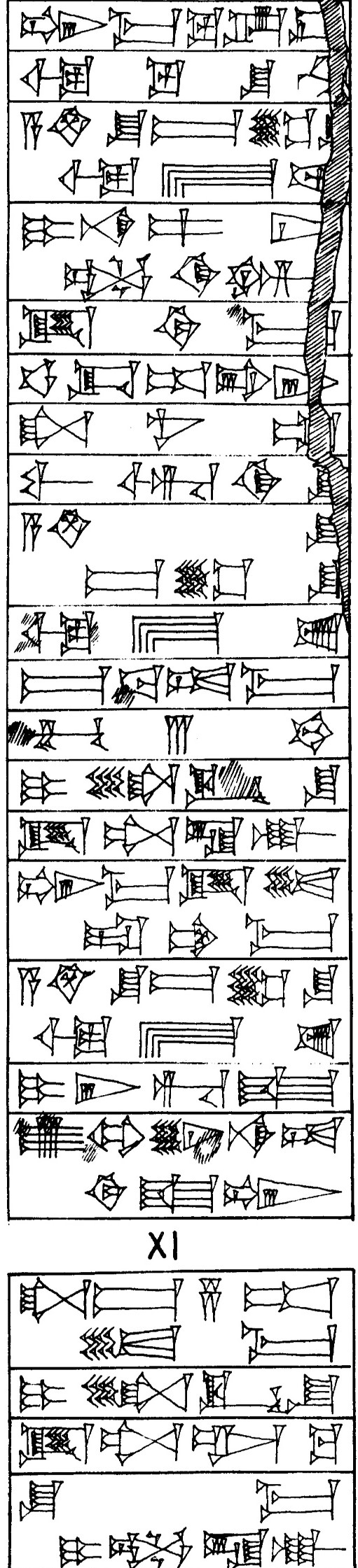
Cuneiform

Law § 30 - Cuneiform - Law Code of Hammurabi

Source: Bergmann (1953, p. 7, col. X–XI, lns. 51–68; 1–4)

Transliteration

šum-ma lu AGA.ÚS ù lu ŠU.ḪA A.ŠÀ-šu gišKIRI6-šu ù É-sú i-na pa-ni il-ki-im id-di-ma ud-da-ap-pí-ir ša-nu-um wa-ar-ki-šu A.ŠÀ-šu gišKIRI6-šu ù É-sú iṣ-ba-at-ma MU.3.KAM i-li-ik-šu it-ta-la-ak šum-ma it-tu-ra-am-ma A.ŠÀ-šu gišKIRI6-šu ù É-sú i-ir-ri-iš ú-ul in-na-ad-di-iš-šum ša iṣ-ṣa-ab-tu-ma i-li-ik-šu it-ta-al-ku šu-ma i-il-la-ak

Source: Huehnergard (2011, p. 330)

Normalization

šumma lū rēdûm ū lū bāʾerum eqelšu kirīšu u bīssu ina pānī ilkim iddī-ma uddappir šanûm warkīšu eqelšu kirīšu u bīssu iṣbat-ma šalāš šanātim ilikšu ittalak šumma ittūram-ma eqelšu kirīšu u bīssu irriš ul innaddiššum; ša iṣṣabtū-ma ilikšu ittalku šū-ma illak.

Source: Huehnergard (2013, p. 82)

Translation

If either a rēdûm or a bāʾerum abandoned his field, orchard, or house on account of the ilkum-service and has gone away, (and) after his departure another took over his field, orchard, or house and has performed his ilkum-service for three years, if he has returned and wants his field, orchard, or house, it will not be given to him; it is the one who took over and has performed his ilkum-service who will perform (it).

Source: Huehnergard (2013, p. 82)

Citation

MLA 9

Dedović, B. "§ 30 - eHammurabi." OMNIKA Foundation, 25 Oct. 2023, ehlaw.org/law/30. [Accessed 14 Nov. 2026]

APA 7

Dedović, B. (2023, October 25). § 30 - eHammurabi. OMNIKA Foundation. https://ehlaw.org/law/30

CMS 16

Dedović, Boban. "§ 30 - eHammurabi." Las Vegas, NV: OMNIKA Foundation. Created October 25, 2023. Modified January 2, 2025. Accessed November 14, 2026. https://ehlaw.org/law/30.

Bibliography

ACH

Abulhab, Saad D. The Law Code of Hammurabi: Transliterated and Literally Translated from its Early Classical Arabic Language. New York, NY: Blautopf, 2017.

CHTP

Bergmann, Eugen. Codex Ḫammurabi: Textus Primigenius. Rome, Italy: Pontificium Institutum Biblicum, 1953.

HAG3

Huehnergard, John. A Grammar of Akkadian (Third Edition). Winona Lake, IN: Eisenbrauns, 2011.

HKEY3

Huehnergard, John. Key to a Grammar of Akkadian (Third Edition). Winona Lake, IN: Eisenbrauns, 2013.

–

OMNIKA Foundation Contributors. "OMNIKA: Digital Mythology Library & Search Engine." Las Vegas, NV: OMNIKA Foundation, accessed November 14, 2023. https://omnika.org. [Visit]

RHL

Richardson, Mervyn E.J. Hammurabi's Laws: Text, Translation and Glossary. New York, NY: T & T Clark International, 2004.

SoT

Sound of Text Contributors. "Sound of Text: AI Text-to-Speech." Accessed November 14, 2023. https://soundoftext.app. [Visit]

eHammurabi Glossary

The § symbol is a shorthand notation for the word 'section'.

Read more

eHammurabi Glossary

Cuneiform is an ancient writing system used by various cultures around Mesopotamia.

Read more

eHammurabi Glossary

Normalization is the application of grammatical rules unto transliterated sound values.

Read more

eHammurabi Glossary

Translation is the conversion of linguistic contents and their meanings from one language into another.

Read more

eHammurabi Glossary

Transliteration is the conversion of sound values from one writing system into another.

Read more